
How the Body Keeps the Score? Bodynamic Analysis's Contribution

Updated: Aug 6
Listen to the Podcast on your favourite app.
In this episode, I want to take you a little deeper into research — in a simple, concrete, graspable way — because I want you to understand how things get coded and imprinted in our system. And when I say coded and imprinted, I mean this very concretely: in our fascia, in our nervous system, in our muscles. And, of course, this impacts the rest of us too.
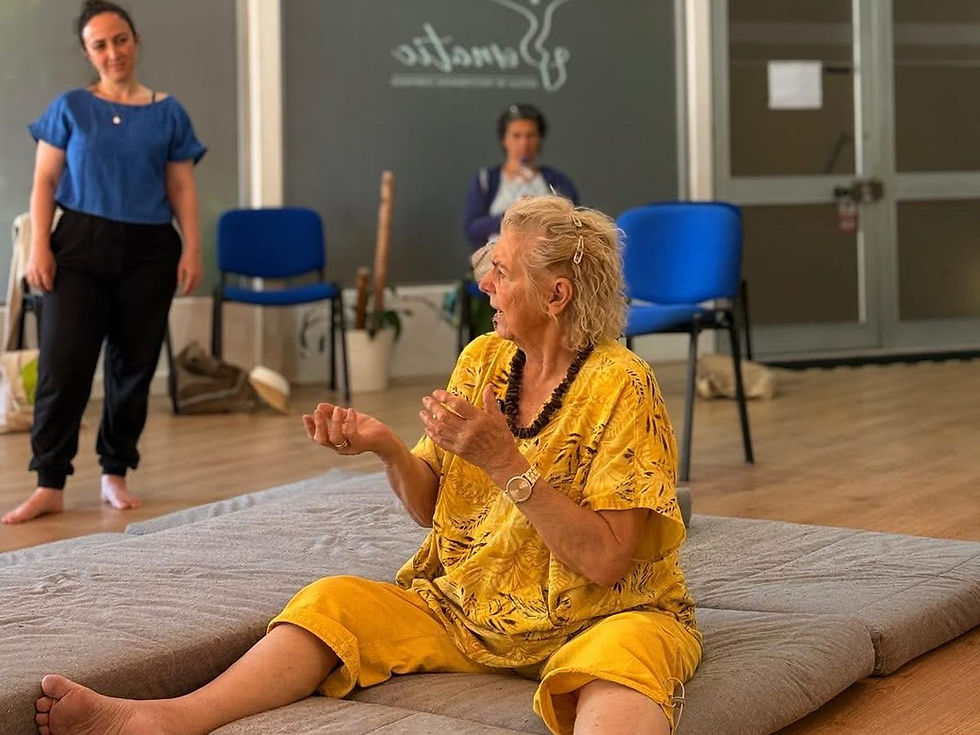
This is part of the psychomotor research done by Lisbeth Marker, in the Bodynamic Analysis system. She began this work in the 1970s, when she started
to notice patterns — that when people were touched, moved, or activated in specific muscles, emotional content would spontaneously arise. She started to ask questions. Already in the '70s, she performed the first research of its kind, creating a map and gathering more than 10,000 reports over a span of five years.
What that research revealed was that different muscles link to different psychological functions, and different muscles become activated into consciousness at different points in our motor development. These are the links.
So when a child — when any of us — goes through an experience, from the early womb and through our development, it's not only the dramatic experiences that leave a mark. Basically every stage of development leaves codings and imprints in our muscles and our tissues.
We use a test called the body map, where we assess more than 120 muscles and tissues across the body, and give each one a colour, a degree. There are six or seven different degrees and colours, but if I simplify it to two, we look at hypertension or hypotension in the muscles. This gives us an indication of the kind of coding, or imprint, that was created within a person's system — and that, in turn, tells us how much energy, awareness, and consciousness they have available; how much power they have to use different ego skills, to set a boundary, to contain emotion, to set limits, to reach out, to ask for support, to receive support, to say no, to take something in when they mean yes, cognitive skills, and many more.

We live in an age where it's become almost mainstream knowledge that the body keeps the score. But beyond this research from Denmark, by Lisbeth Marcher, we don't yet really grasp how it keeps the score in the body — what the way is, that it's being kept.
There's an assumption that what gets scored are traumas. That's not true. In fact, each one of us — even without trauma — carries codings, carries imprints.
These codings and imprints shape our perception, our ability to express things, our capacity.
This is the material we work with in sessions with people. This is where we organise and bring more into consciousness, into awareness, and activate these muscles, so we can shift these codings and imprints into better flow, better coherence, more connection.
Some of these codings sit within the range of what we can become aware of. But there are also codings that lie outside our reach of consciousness — and we can see these on the map we build for each person, based on what they come to us asking for. Part of the way our system gets cluttered is that some of these codings, these imprints, function like defences — and they really do impact our perception, our capacity to do certain things.
So there are things we know we need to do, for example, and yet we're unable to do them. That gap lives within the codings, within the body. If I don't have the energy, the consciousness in the motor function connected to a given psychological function, I am unable — I don't have the energy, the internal knowing, for how to do it. This is why I often say: knowing is great, but it's not enough. Knowing alone doesn't change the coding. What changes the coding is the movement within the knowing — the connection, the link between the body, the sensation, the insight, and our higher brain capacities.
In many ways, I always wish we could sit together for this, because I know this topic has the potential to raise a lot of questions, a lot of curiosity — as I often find when I talk about it. Bodynamic Analysis is a vast body of knowledge, with many different modalities that are, in the end, integrated, working together. But because it's so nuanced and complex, we have to learn them separately, one at a time. So every time I touch on this, I can only bring you a piece of it — enough, for this episode, to point toward what it means and how it shapes our perception. We'll dive further into this in episodes to come, and we've touched on parts of it before too. We need to break it down into small, digestible pieces, so we can build the multidimensional reality it actually is.
Listen to the Podcast on your favourite app.


Comments